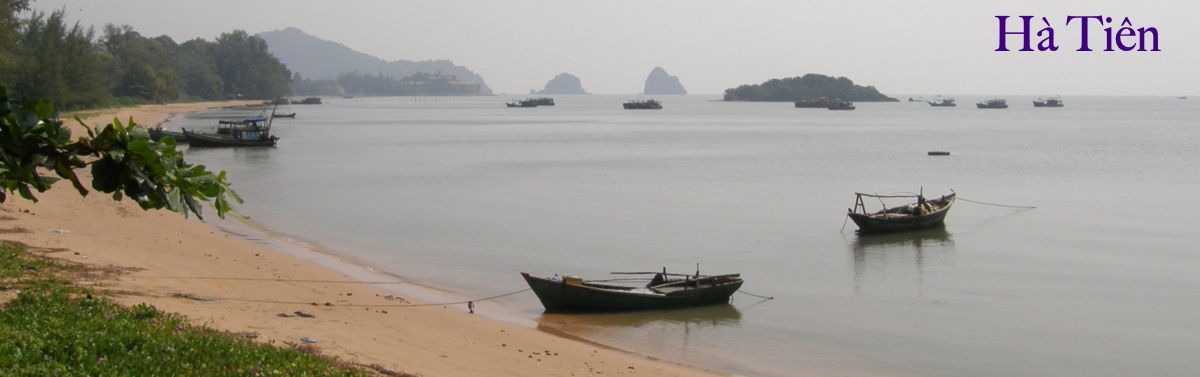
HÀ TIÊN
Hà Tiên is one of my favorite destinations in the south of Vietnam. Lodged in hilly terrain around a sheltered harbor, it is a lovely landscape with a remarkable history as a trading entrepot founded by a Chinese émigré, Mạc Cửu, subsequently transformed by his son, Mạc Thiên Tứ, into a model Confucian city-state. Yet it has never really been promoted as a destination for foreign tourists, who are presumed to be more interested in the white-sand beaches of Phú Quốc island.
Strangely, my introduction to the exotic history of the Mạc kingdom came not from any French or Vietnamese sources, but through the work of Nicholas Sellers, an officer who was stationed at the Special Forces camp overlooking the town during the “American war.” In 1983, Sellers published The Princes of Hà Tiên, through the good offices of a very small publishing house in Brussels. Though the book’s physical appearance is unprepossessing—the text appears almost as typescript—the work itself is a fairly sophisticated synthesis of materials ranging from the accounts of French and Chinese visitors in the 18th century to the Mạc family history. [The latter presumably written in Han Chinese and/or translated into quốc ngữ—Sellers gives credit to a learned man of the town, Quách Ngọc Bá, for his assistance in this regard.]
Sellers begins the historical narrative on a personal note, associating the early days of the Mạc settlement at Hà Tiên with the founding of his native state of Pennsylvania in 1681:
On almost precisely the same date that William Penn secured a grant and the royal assent to his Pennsylvania colony in the New World, on the opposite side of the globe a Chinese adventurer by the name of Mạc Cửu had succeeded in establishing a small state under very similar auspices
… There are curious likenesses between the early histories of Ha-tien and the Pennsylvania colony. Each owed its existence in 1681 to a sole founder: in both cases a man of singular vision, leadership and compassion. Both states were brought into being by the favor of a remote monarch and both were peopled by refugees seeking to live in peace. harmony and simple prosperity
… Most significantly, both Pennsylvania and Ha-tien in their own times captivated the particular interest of the European intellectual community, who contrasted the political experimentation of those new states, and the tranquil prosperity enjoyed by each, with the troubled and tyrannical nations of Europe.
The similarity of dates is not nearly as exact as Sellers implies, as we have no documentary evidence to confirm when the Cambodian king placed Mạc Cửu in charge of this once-active port town. But the rest of the comparison holds true, even if it is—as Sellers freely admits—no more than coincidence.
Of the terrain, he writes:
Around Ha-tien and to the immediate north in the « Seven Mountains» region, are to be found the only mountains and hills in the Delta. These are precipitous slopes which were once islands in the Bay of Thailand, and now, rising incongruously from the flat rice fields or coastal swamps, still have the aspect of islands in a grassy sea. Oyster shells embedded in the rocks can be found high up in these hills, indicating that the sea level must have been two hundred feet above its present level, and suggest that a gradual geographic upheaval may have accompanied the accumulation of alluvial deposits. The large island of Phu-qu6c, (4) and the scattered smaller ones such as Pula Dama, Pula Panjang and Pulo Way, are the remains of this island chain.
Sellers goes on to give a full account of the rising prosperity of Hà Tiên and the laudatory descriptions penned by Chinese envoys and the French adventurer and philosophe, Pierre Poivre, continuing the tale through the wars with Siam and the Tây Sơn, and then into the 19th century. Sometimes it colorizes the story of the first two Mạc princes with sentimental assumptions, but the work is sound enough to find its way into an occasional scholarly citation.
This was a remarkable accomplishment, but as far as I know, it is the only book that Sellers ever published, aside from a genealogical history of his own family in Pennsylvania. So, his book on Hà Tiên is a one-of-a-kind thing, found only in the holdings of a few dozen libraries around the world.
Since my first reading of Princes of Hà Tiên, much more has been written about Hà Tiên.
- In 2007, Li Tana and Paul A. Van Dyke published a fascinating paper detailing the economics of the Mạc city-state (“Canton, Cancao, and Cochinchina”).
- 2008. A scholarly resident of Hà Tiên, Trương Minh Đạt, published Nghiên cứu Hà Tiên in 2008, rendering a wealth of local detail.
- 2011. Brian Zottoli provides an extensive comparison of Portuguese, Chinese, and Vietnamese sources (including the Mạc family history, the Mạc thị gia phả) in a thesis titled Reconceptualizing Southern Vietnamese History form the 15th to 18th Centuries: Competition along the Coasts form Guangdong to Cambodia.
- 2019. Claudine Ang adds yet another layer with her fascinating exploration of Mạc Thiên Tứ’s poetical and political collaborations with the Nguyễn-appointed governor of the south (Poetic Transformations: Eighteenth-Century Cultural Projects on the Mekong Plains).
The Mạc Family in Hà Tiên
Hà Tiên’s heyday as a prosperous city-state was brief but very bright, spanning the lifetimes of two great lords. It was founded in the 1680s by a Chinese émigré, Mạc Cửu, who had served for several years at the Khmer court. It came to be regarded as a model kingdom under his son Mạc Thiên Tứ, who managed to impress both Chinese envoys, who thought his fiefdom had achieved a high level of culture by classical Confucian standards, and the French adventurer Pierre Poivre, who saw Tứ as the epitome of an enlightened modern ruler.
This was all torn apart by Siamese invasions and the civil war between the Nguyễn lords and the Tây Sơn rebels in the 1770s. During the long civil war that raged over three decades, Hà Tiện’s political status was ambiguous, as it owed allegiance both to Chakri of Siam and Nguyễn Phúc Ánh. By the time peace came, much of Hà Tiên’s commerce had died off, and it became a remote and relatively small corner of the “Six Provinces” (Lục Tỉnh) that made up the southern region of Việt Nam.
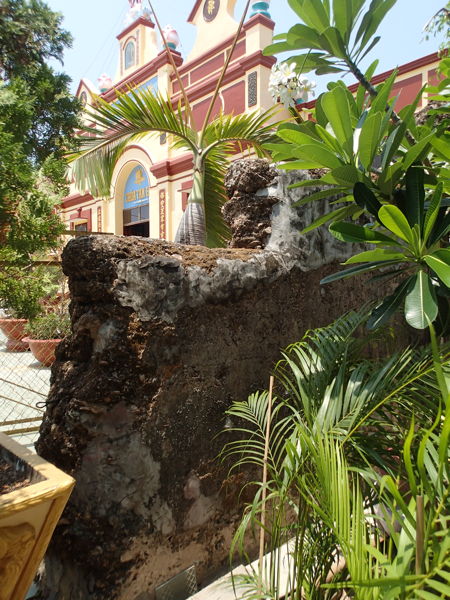
This is believed to be a remnant of the wall of the old Mạc citadel, still standing next to the Tam Bảo pagoda that was originally endowed by Mạc Cửu.
Early Names: Peam, Cancao, and Ponteamas,
According to Sellers, the provincial capital that bore the name Banteay Meas lay further inland, and the actual port was called Peam> by the Cambodians and Mang Khảm by the Vietnamese.
However, nothing like these names appear on the early western maps of this period. Instead, they show “Langor,” “Corol,” and “Tarvana.” Dutch and English geographies identify these as important towns, but no one has been able to link these names to Khmer or Vietnamese placenames, or even to specific locations. Some have speculated that “Langor” is actually “Angkor”—this could be a case of the port being given the name of the kingdom, though Angkor was no longer an active polity.
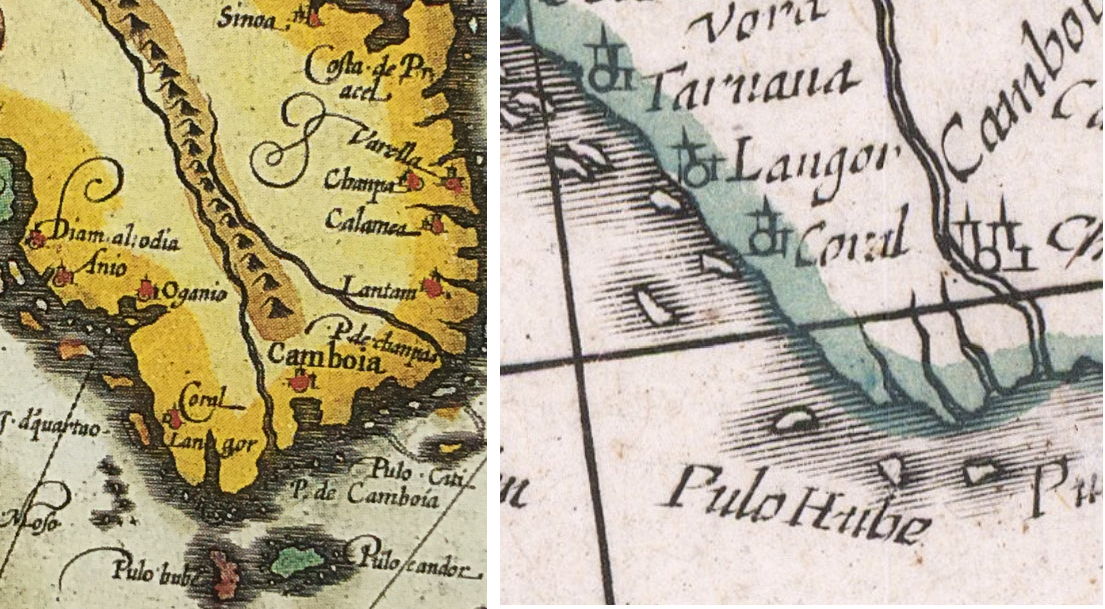
Early maps of the southwestern coast by Hondius (1609) and Blaeu (1635).
In contrast, we have a great deal of evidence that Chinese merchant-captains called the harbor Can Cao, meaning “port mouth,” or, in the English phrasing, “Portsmouth.”
Can Cao
港口
The name “Can Cao” continued to be used during Mạc Thiên Tứ’s reign, and was applied as a political toponym for the entirety of his realm; hence, “Cancao” was sometimes used as a placename on the western branch of the Mekong, probably referring specifically to Trấn Giang (modern-day Cần Thơ).
As western cartographers became better informed about the region, they began to mark the port as Ponteamas or Ponthiamus>, a transliteration of “Banteay Meas.” This name began showing up on maps in the middle of the 18th century (ca. 1740s). In Voyages d'un philosophe (1769), Pierre Poivre had it both ways, explaining that he had visited “a small territory called Cancar, and known on the marine charts by the name Ponthiamus” (… un petit territoire nommé Cancar, et connu sur les cartes marines sous Ie nom de Ponthiamas).
Hà Tiên: River of Spirits
After Mạc Cửu allied himself with the Nguyễn lords, his fief was given the name Hà Tiên, meaning “River of the Spirit(s).” The word tiên (Chinese xian 仙) is a classical term for the Taoist immortals, or “perfected beings,” who are eight in number (in the north, the Vietnamese had their own pantheon of four “immortals”).
Hà Tiên
河仙
The name “Hà Tiên” first appears in the Nguyễn chronicles in 1708, though that is no guarantee of its use at that time. (The official historians could have retroactively applied the term when describing the first contacts between Mạc Cửu and the court at Huế.) The entry for that year notes that the name was given because such immortals had often been seen along the river. It’s possible that this reputation has something to do with the legend that a golden Buddha appeared at the bottom of a nearby stream as an augury of Mạc Thiên Tứ’s birth.
The name Hà Tiên, as given by the Nguyễn court in Phú Xuân (Huế), may have been reserved for official communications. In common parlance, as we’ve seen, voyagers knew it either by the Chinese name Cancao or the Khmer name Ponteamus. “Atien” or “Hà Tiên” did not appear on western maps until the early 19th century.
Mạc Thiên Tứ was well-versed in classical Chinese tradition, and soon after he succeeded his father, he began to work on a set of ten odes describing the harmonious scenery of his domain—the Hà Tiên thập cảnh ( 河仙十景).
The following list combines the names as given by Trịnh hoài Đức (Gia Định Thành thông chí, in quốc ngữ translation (both word-for-word and semantic), with Claudine Ang’s English translation of each title (Poetic Transformations) and the location of each scene (based on Nicholas Sellers and my own best guesses).
1. Golden Islet Blocking Waves
Kim Dữ lan đào (金嶼攔濤)
Dịch nghĩa: Đảo Vàng ngăn sóng
Đại-Kim-Du peninsula, also known as Pháo-dài point: the arm of land that partially encloses the entrance of Hà-Tiên harbor.
2. Verdant Folds of Screen Mountain
Bình San điệp thúy (屏山疊翠)
Dịch nghĩa: Núi bình phong lớp lớp xanh
The east slope of Mỹ-đức Hill (now the site of the Mạc ancestral temple).
3. Dawn Bell at the Temple of Seclusion
Tiêu tự thần chung (蕭寺晨鐘)
Dịch nghĩa: Chuông mai chùa vắng
The Tam Bao Buddhist temple, constructed adjacent to the walls of the Mạc citadel.
4. Night Drum on River Wall
Giang thành dạ cổ (江城夜鼓)
Dịch nghĩa: Trống canh đêm thành lũy bên sông
This scene could have been anywhere along the ramparts that extended along the river, but presumably it was close to the citadel.
5. Stone Grotto Swallows Clouds
Thạch Động thôn vân (石洞吞雲)
Dịch nghĩa: Động đá nuốt mây
Thạch Động mountain, which became the site of a Buddhist cave-temple.
6. An Egret Descends from Pearl Cliff
Châu Nham lạc lộ (珠岩落鷺)
Dịch nghĩa: Cò đậu Châu Nham.
Pearl Cliff is now called Núi Trat; it is part of the Bấi-ớt mountains, forming the tip of a peninsula about 10 kilometers south of Hà Tiên.
7. Moon’s Reflection on East Lake
Đông Hồ ấn nguyệt (東湖印月)
Dịch nghĩa: Trăng in Đông Hồ.
“East Lake” is on the outskirts of the town, surrounded by hills, one of which has a colonial-era water tower.
8. Clear Waves on South Bay
Nam Phố trừng ba (南浦澄波)
Dịch nghĩa: Sóng lặng bến Nam.
Nam Phố is the partially-enclosed bay of Hà Tiên.
9. Rustic Dwellings at Deer Cape
Lộc trĩ thôn cư (鹿峙村居)
Dịch nghĩa: Xóm quê Mũi Nai.
Sellers identifies Lộc trĩ as “Deer Mountain,”
located at the cape; site of old lighthouse.
10. Mooring to Fish at Sea-Perch Creek
Lư khê ngư bạc (鱸溪漁泊)
Dịch nghĩa: Thuyền câu đậu rạch Vược.
Lư khê (Rạch Vươc) was near Thuận Yên village; Mạc Thiên Tứ had a fishing pavilion on its banks.
Bishop Pigneaux and the Hòn Đất Seminary
There is another famous site in the vicinity of Hà Tiên that has seemingly vanished from the landscape: the seminary at Hòn Đất. The Société des Missions Étrangères de Paris (MEP) had originally founded its Southeast Asian seminary in Ayutthaya (1665), but, a century later, it was endangered by Burmese attacks on the Siamese capital.
The head of the seminary, Jean-Baptiste Aloysius Artaud, chose to relocate to Hà Tiên. Mạc Thiên Tứ was well-disposed to Christians, the population of his kingdom being rather small for the grand schemes that he was contemplating. Because Portuguese missionaries already had staked out their place in the city proper, Artaud was allowed to settle his community “two leagues” south of its walls.
However, trouble was not far behind him, as Hà Tiên had long been the target of its Siamese trading rivals on the Menam estuary. Artaud died in the midst of troubles in 1769, and Siamese raids destroyed the small settlement a year later. the survivors of the Siamese raids fled to Malacca and then Pondicherry. It was not until 1808 that the seminary could resume operation, on the island of Penang, where it is still in operation.
The few years spent at Hòn Đất merit no more than a brief entry in the chronology of the seminary, and it is similarly overlooked in the local history of Hà Tiên. However, this outpost deserves special notice for the role that it played in the saga of the Nguyễn restoration. This was thanks to Artaud’s young colleague, Pierre Pigneaux, consecrated as the Bishop d”Adran (1774), who returned to Hòn Đất to continue the MEP’s missionary work in Cochinchina.
In 1777, after the Tây Sơn captured Saigon and tracked down and massacred most of the Nguyễn royal family, Pigneaux had a remarkable encounter with one of the handful of survivors, Prince Nguyễn Phúc Ánh. Prince Ánh was only fifteen years old at the time. Pigneaux saw great promise in the young fugitive, and began their long association by helping him to hide in the woodland at Hòn Đất.
Prince Ánh was shortly able to return to Saigon as the figural head of a coalition of Nguyễn loyalists. But the Tây Sơn continued their seasonal attacks, finally occupying Saigon, seemingly for good, in 1783. As the Tây Sơn tried to assert control over the far reaches of the south, Pigneaux abandoned Hòn Đất and took on a new vocation as one of Nguyễn Ánh’s most important counselors.
Over the next two decades, Pigneaux would procure advanced weaponry, recruit several talented French adventurers, and work on a legal code, but he is best remembered for taking Nguyễn Ánh’s young son, Prince Cảnh, on an epic journey to France, where he would have an audience with Louis XVI, play with the dauphin, and meet the American ambassador, Thomas Jefferson. (Jefferson, an avid horticulturalist, was very interested in obtaining a sample of Cochinchinese rice.)
By any measure, Hòn Đất has to be one of the most significant historical sites in the south of Vietnam, so why wouldn’t there be at least a historical marker?
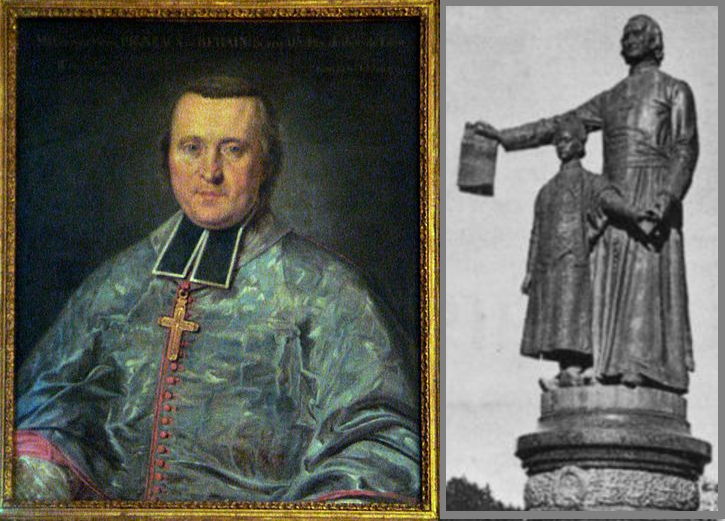
Painting of Pigneau at the time of his visit to Versailles with Prince Cảnh (1787); statue of Pigneau standing with young Cảnh in front of the Notre-Dame cathedral (Nhà thờ Đức Bà) in Saigon.
The answer probably has a great deal to do with anticolonial sentiment, which blamed Nguyễn Phúc Ánh (Gia Long) for the failures of a dynasty that collapsed in the face of French demands. Critics saw Nguyễn Ánh’s failed attempt to get aid from France and his use of French adventurers as advisors during the final phase of the civil war (1788-1802) as the first steps on a road that led to the loss of independence. For their part, the French colonialists were happy to play up the idea that Nguyễn Ánh had welcomed them, and promoted Pigneaux as a symbol of France’s kind intentions towards their Annamite subjects (expressed as the mission civilisatrice).
This idea was given concrete expression in the statue of Pigneaux and Prince Cảnh that stood in front of the Saigon cathedral until it was toppled in the halcyon days of August 1945. The statue depicted Pigneaux, clasping the hand of his long-time pupil, while holding aloft the never-enacted treaty that the bishop had negotiated with King Louis XVI in 1787. This notion was turned around in Vietnamese tradition, which blamed Gia Long as the man who “brought home the snake that killed the chicken” (cõng rắn cắn gà nhà).
However, the idea that Gia Long sold his soul and opened the door to the French is completely ahistorical. Reading the compilations of missionary letters and the correspondence of “Les Français au service de Gia-Long,” it is quite clear that the French participation in the Tây Sơn war was limited to a handful of men, the best of whom—Dayot and Olivier—were gone before the dénouement of the civil war in 1800-1802. The last of the “French mandarins” left Huế in the early 1820s.
True or not, this politicized “history read backwards” goes a long way towards explaining why it is so difficult to find Pigneaux’s pied-a-terre on the gulf coast. Not that I haven’t tried. On one trip, I stopped in the town of Hòn Đất to inquire at the Catholic church about the old seminary, but the priest and his colleagues professed ignorance of the historical subject. In fact, as I later realized, the old seminary was probably nowhere near the modern-day town of Hòn Đất. But where that nowhere was continues to intrigue me.
- Poetic Transformations: Eighteenth-Century Cultural Projects on the Mekong Plains, Claudine Ang, Harvard University Press, 2019.
- The Princes of Hà-tiên (1682-1867). Nicholas Sellers, published by Thanh-Long, Brussels, 1983.
- “Canton, Cancao, and Cochinchina: New Data and New Light on Eighteenth-Century Canton and the Nanyang,” Li Tana and Paul A. Van Dyke, Chinese Southern Diaspora Studies, vol. 1, 2007.
- “Thoughts on a Chinese Diaspora: The Case of the Mạcs of Hà Tiên,” Liam C. Kelley, in Crossroads: An Interdisciplinary Journal of Southeast Asian Studies, Vol. 14, No. 1 (2000).
- Voyages d'un philosophe ou observations sur les moeurs et les arts des peuples de l'Afrique, de l'Asie et de l'Amérique, P. Poivre, Paris, 1795 (originally published 1769).
- Nghiên cứu Hà Tiên, Trương Minh Đạt, Văn hóa - Xã hội, 2008.
- Pierre Pigneaux : Evêque d'Adran et mandarin de Cochinchine, Frédéric Mantienne, Les Indes Savantes, 2012.